
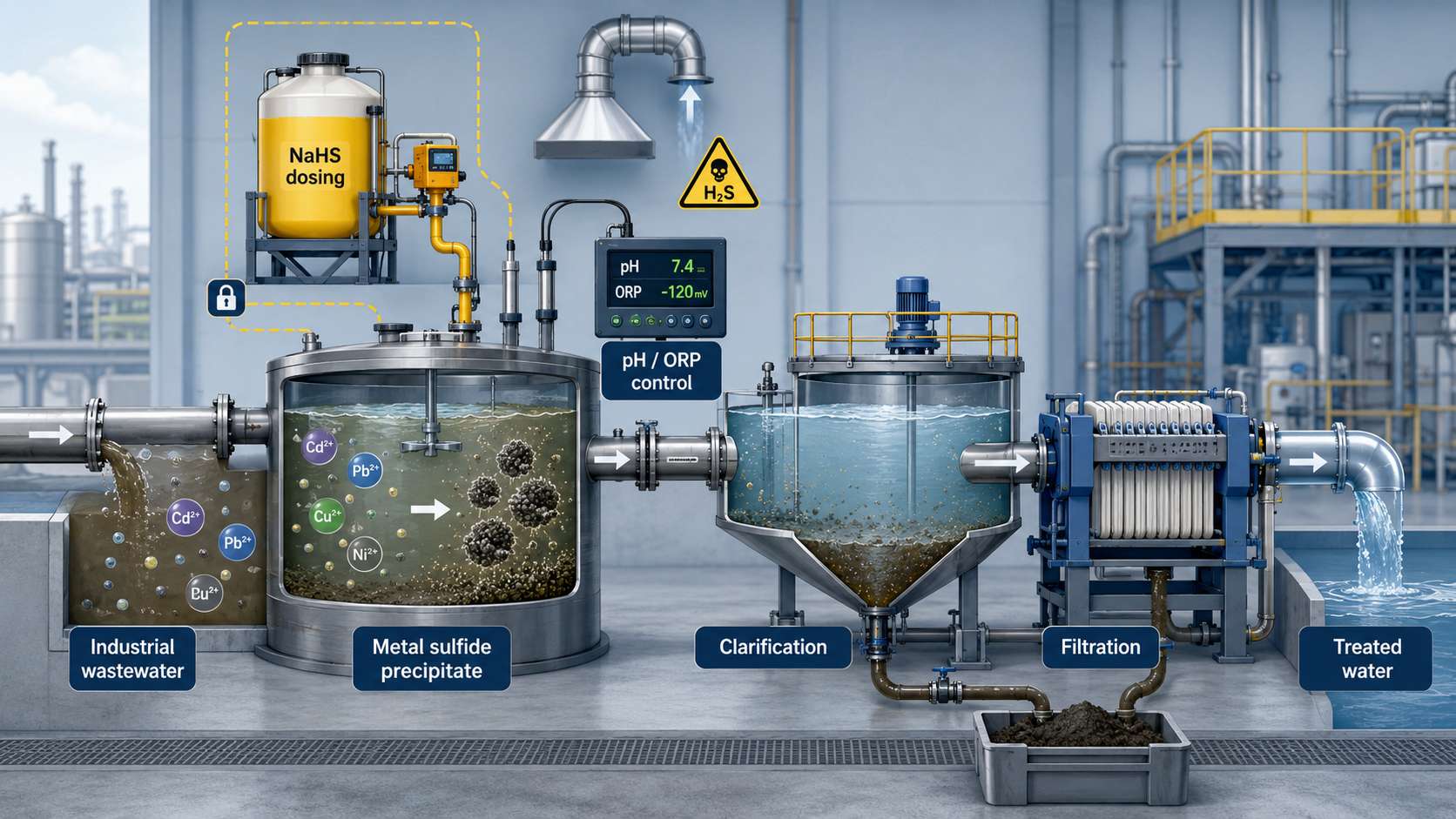
Industrial wastewater may contain dissolved metals that are difficult to remove by hydroxide precipitation alone, especially when discharge limits are low or the metals are complexed. Sulfide precipitation can provide another treatment route because many metal sulfides have low solubility. At BOINTE, we discuss Utilisations de l'hydrosulfure de sodium within a complete treatment design, not as a universal dosing instruction. NaHS performance and safety depend on the water chemistry, equipment, controls, and sludge-management plan.
The Treatment Principle
During the dissociation process of NaHS, there will be sulfides that depend largely on the pH level. They react with the metal ions that are present in the water to produce metal sulfides in the solid state. Metal sulfides can be extracted from the solution by clarification, flotation, and filtration aided by the coagulation process. The simplified equation helps us understand the goal, but the wastewater has other ions and components.
Where Sulfide Precipitation Can Help
Applications can include wastewater from mining, mineral processing, metal finishing, plating, electronics, batteries, pigments, and some chemicals. Copper, lead, cadmium, mercury, zinc, and nickel can react to the treatment, but the effectiveness depends on the matrix. No general list of applications of sodium hydrosulfide can guarantee the result for any specific effluent.
Sulfide treatment may be used as the main precipitation step or as polishing after hydroxide removal. A two-stage approach can reduce bulk metals first and then target residual concentrations. It may also help when amphoteric behavior or metal complexes make hydroxide treatment less effective. The BOINTE water treatment category provides a practical entry point for discussing the complete chemical program.
| Treatment Approach | Main Function | Cas d'utilisation typique | Buyer Concern |
| Hydroxide precipitation | Removes bulk dissolved metals by forming metal hydroxides | General industrial wastewater with moderate limits | pH range, sludge volume, incomplete removal of complexed metals |
| NaHS sulfide precipitation | Forms low-solubility metal sulfides | Low discharge limits, residual metals, or metals less responsive to hydroxide treatment | H2S control, accurate dosing, residual sulfide, sludge handling |
| Two-stage treatment | Uses hydroxide removal first, then NaHS polishing | Variable wastewater or stricter final discharge targets | Process testing, control strategy, added equipment, sludge classification |
This comparison shows why NaHS should be selected as part of a tested treatment strategy rather than as a simple replacement for existing precipitation chemistry.
The pH and ORP Are Operating Variables
The pH controls sulfide speciation and the risk of hydrogen sulfide release. Lower pH increases the fraction present as dissolved H2S, creating a serious inhalation hazard and potentially wasting reagent. Excessively high pH can change metal chemistry, increase caustic demand, or interfere with downstream treatment. The operating range must be established through testing and engineering review.
Oxidation-reduction potential, or ORP, is often used as a process indicator because it responds to sulfide addition. It is not a direct universal measurement of residual sulfide or metal removal. Probe condition, location, mixing, temperature, and wastewater composition affect the signal. A control strategy should combine ORP or other online indicators with pH, flow pacing, laboratory verification, and defined alarm limits.
Dose Must Be Established by Testing
The stoichiometric metal demand provides a starting point, not a final dose. Oxidants can consume sulfide. Complexing agents can keep metals in solution. Other ions can precipitate or adsorb reagent. Incomplete mixing can create local excess and poor overall removal. A treatability program should use representative samples across normal and upset conditions.
Jar tests can screen pH, NaHS dose, reaction time, mixing, coagulant or polymer support, settling, filtrate quality, and residual sulfide. The test should measure the regulated metals and relevant secondary parameters. Pilot or controlled full-scale trials are appropriate when the wastewater varies significantly or the compliance risk is high.
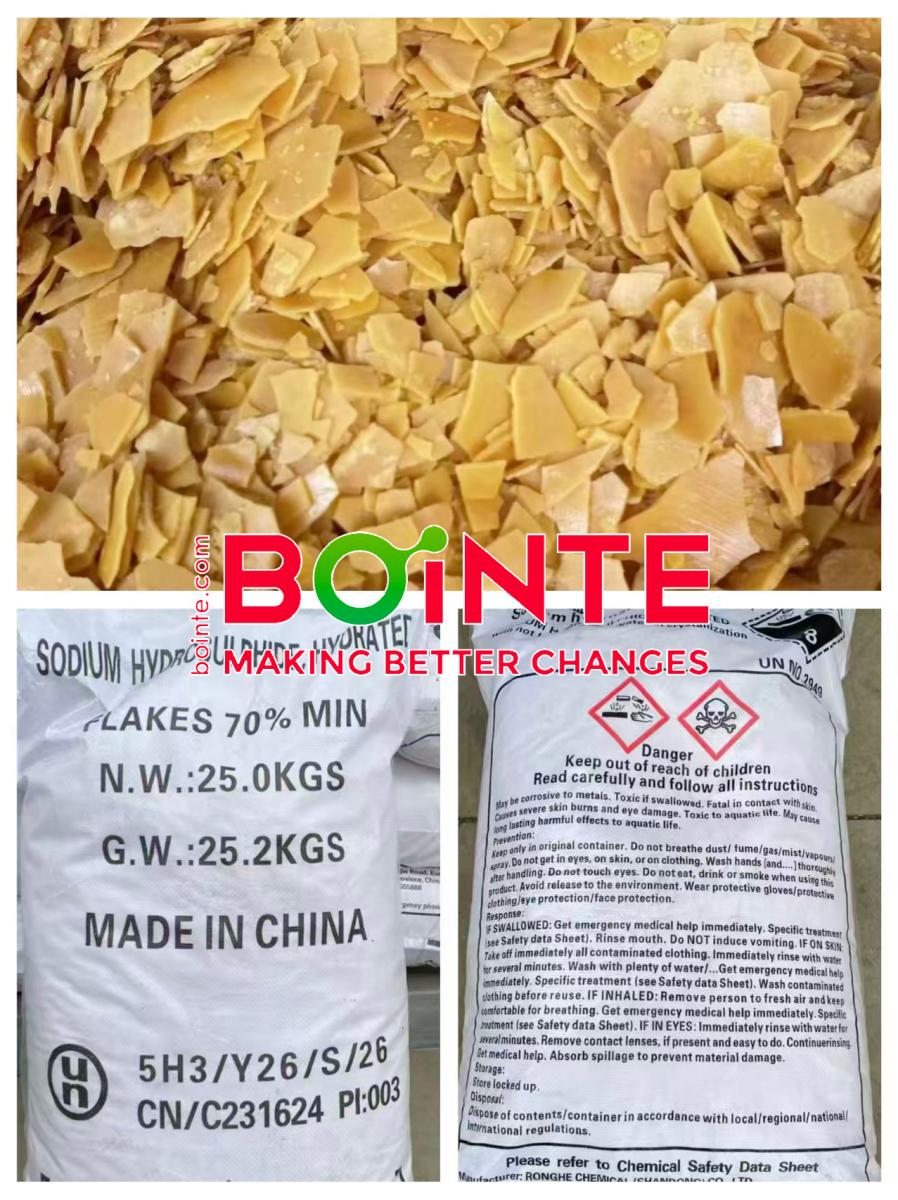
BOINTE offers 32%, 42%, and 50% liquid grades and 70% solid product subject to contract. For wastewater dosing, liquid can simplify metering, while solid may suit a site with a properly engineered preparation system.
Mixing, Reaction, and Solid Separation
Fast dispersion helps prevent local overdose and promotes contact with dissolved metals. The reaction tank should provide controlled mixing and sufficient residence time without increasing gas release. The following separation step must handle fine metal-sulfide particles. Coagulation, flocculation, lamella clarification, dissolved-air flotation, media filtration, or filter presses may be considered according to solids characteristics and flow.
Sludge is part of the treatment result. It may contain concentrated hazardous metals and residual sulfide. Dewatering behavior, stability, classification, transport, and permitted disposal or recovery must be evaluated. A process that meets the water limit but creates an unmanaged sludge problem is not complete.
Control Hydrogen Sulfide Exposure
Sodium hydrogen sulfide can release H2S if acid enters the system or pH falls. Storage and dosing should therefore use compatible closed equipment, secondary containment, ventilation, gas detection, alarms, controlled access, and emergency response procedures. Acids must be segregated physically and procedurally. Backflow prevention and interlocks should be considered where an incompatible stream could reach the reagent system.
Operators need training on the SDS, transfer, sampling, alarm response, spill control, and first actions during suspected exposure. Respiratory protection and rescue arrangements must be set by qualified site professionals; untrained personnel must not enter a contaminated area. These are basic conditions for responsible sodium hydrosulfide uses.
Prevent Overdose and Residual Sulfide
Adding more reagent is not a reliable way to improve removal. Overdose raises cost, can leave sulfide in the effluent, may create odor or gas risk, and can affect downstream biological or oxidation processes. Flow-paced dosing with pH and process feedback is preferable to fixed manual addition when wastewater load varies.
Final polishing may use controlled oxidation or another treatment step when residual sulfide must be reduced, but oxidant addition requires careful design to avoid unwanted reactions or re-dissolution. The sodium hydrogen sulfide treatment guide shows how chemical treatment connects with physical, biological, and tertiary stages.
Define Procurement and Quality Requirements
The purchase specification should state concentration, relevant impurities, package, test method, certificate of analysis, batch identification, and delivery schedule. Receiving procedures should inspect labels, seals, package condition, and quantity. Storage capacity and delivery frequency should match consumption and emergency inventory without creating unnecessary hazardous stock.
Pour NaHS, sodium hydrosulfide, the supplier should also review the site’s package and unloading method. BOINTE can discuss drums, bulk tanks, or solid bags, subject to route, regulation, and equipment compatibility. The quotation must identify what is included rather than relying on a generic product name.
Request a Treatment-Supply Quote
Upload a recent water analysis, flow range, target metals, current pH, expected monthly NaHS use, destination, and packaging preference through our online support form. We can quote supply promptly and identify the information your treatment specialist should confirm before dosing.